
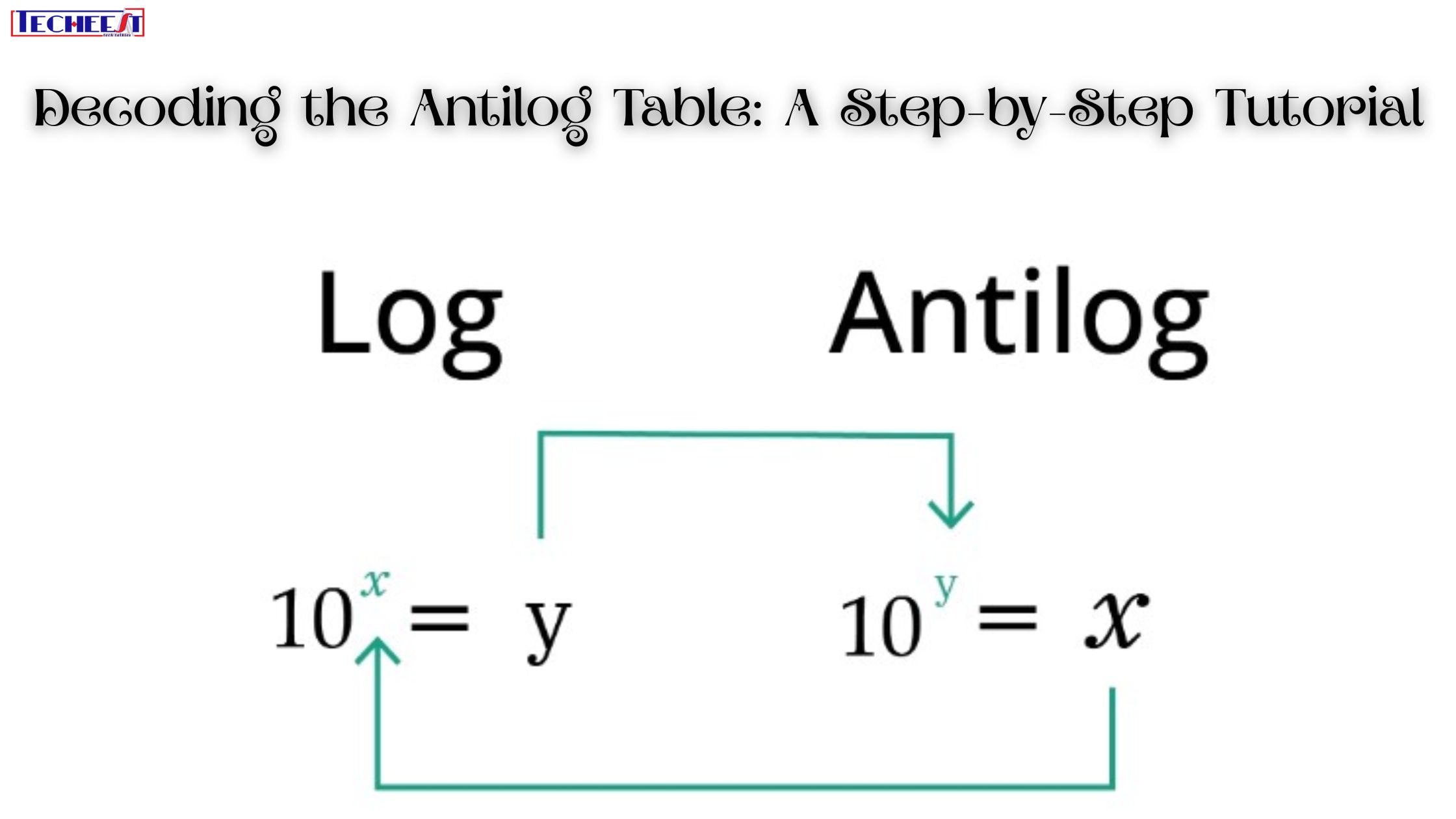
Antilogarithm, or “antilog”, is the inverse operation of the logarithm. While the logarithm answers the question, “To what power must the base be raised to obtain a certain number?”, the antilog answers, “What number is produced when the base is raised to the power of a given number?”
In the world of computing, antilog tables (often called “tables of antilogarithms” or simply “antilog tables”) are special tools used to quickly find the antilog of a common logarithm (logarithm to base 10). Before the advent of modern calculators, these tables were necessary to perform complex multiplication, division, and exponentiation.
This comprehensive guide will decode the antilog table, providing a detailed, step-by-step tutorial on how to use it accurately and understand the mathematical theory behind it.
1. 🔍 Understanding the Structure of an Antilogarithm
To use the antilog table effectively, you must first understand the structure of the logarithm itself. A common logarithm (base 10) of any positive number N is always expressed in two parts: the Characteristic and the Mantissa.
log_{10}(N) = Characteristic + Mantissa
When you are asked to find the antilog of a number, say x = 3.6542, this number x is the logarithm, and its two parts are:
- Attribute (integer part): This is the integer part of the logarithm, which determines the magnitude or the position of the decimal point in the final answer.
- Example: In 3.6542, the characteristic is 3.
- Mantissa (Fractional Part): It is the fractional or decimal part of the logarithm, which determines the order of significant figures in the final answer. This is the only part for which you use the antilog table.
- Example: In $3.6542$, the mantissa is .6542.
Crucial Rule: The mantissa must always be a positive value for the antilog table to work correctly.
2. 📖 The Anatomy of the Antilog Table
The antilog table is specifically designed to work with the mantissa (decimal part) of logarithms. It is a four-digit table, generally structured into three main sections:
- First column (row header): This column lists the first two digits of the mantissa, ranging from .00 to .99. You use this to select the correct starting row.
- Main Columns (Columns 0 to 9): These ten columns correspond to the third digit of the mantissa (0 to 9). This is where you get the primary value.
- Mean Difference Column (Columns 1 to 9): These nine columns correspond to the fourth digit of the mantissa (1 to 9). These values are added to the primary value to improve accuracy.
The Mathematical Basis:
Finding the antilog of x is equivalent to calculating 10x
If x = C + M, where C is the characteristic and M is the mantissa, then:
Antilog(x) = 10^x = 10x =10(C+M) = 10M * * 10M
- The antilog table gives you the value of 10M.
- The characteristic C is used to multiply the result by 10C, which is simply moving the decimal point.
3. 📝 Step-by-Step Tutorial: Using the Antilog Table
Let’s use a complete example to demonstrate the process.
Example: Find the Antilog of 2.8763
Step 1: Identify the Characteristic (C) and Mantissa (M)
- Characteristic (C): The integer part.
C = 2
- Mantissa (M): The fractional part.
M =.8763
Step 2: Locate the First Two Digits of the Mantissa (Row)
Look for the row in the leftmost column (the row headers) that corresponds to the first two digits of the mantissa, which is .87.
Step 3: Use the Third Digit (Main Column)
Move horizontally along the row you located in Step 2 until you reach the column corresponding to the third digit of the mantissa, which is 6.
- Hypothetical Value: You might find a number like 7500.
Note: This is a 4-digit number found in the table. Mentally, you can think of it as 0.7500, but the table just gives the significant digits.
Step 4: Use the Fourth Digit (Mean Difference Column)
Continue along the same row until you reach the column under the Mean Differences corresponding to the fourth digit of the mantissa, which is 3.
- Hypothetical Value: You might find a single-digit number like 5.
Step 5: Add the Values (Finding $10^M$)
Add the value found in Step 4 (Mean Difference) to the value found in Step 3 (Main Column).
Table Value = (Value from Column 6) + (Value from Mean Difference 3)
Table Value = 7500 + 5 = 7505
This four-digit sequence, 7505, is the sequence of significant digits for the antilog of the mantissa 10.8763.
Step 6: Determine the Position of the Decimal Point (Using C)
This is where the Characteristic (C=2) comes into play. The rule for placing the decimal point is:
The number of digits before the decimal point in the final answer is always C + 1.
- Since the characteristic C = 2, the number of digits before the decimal must be 2 + 1 = 3.
- Take the sequence of digits (7505) and place the decimal point after the third digit.
Antilog(2.8763) = 750.5
4. ➖ Handling Negative Logarithms (Negative Characteristic)
A common point of confusion is finding the antilog of a negative number, such as -1.3458.
The Error to Avoid
You cannot simply split -1.3458 into C=-1 and M=0.3458 because the mantissa must be positive. If you were to add -1 and +0.3458, the result is -0.6542$, not -1.3458$.
The Correct Transformation (The Bar Notation)
You must convert the negative logarithm into the form where the characteristic is negative but the mantissa is positive. This is done by adding and subtracting the next highest integer:
- Take the number: -1.3458
- Identify the next highest (more negative) integer: -2
- Add and subtract this integer:
-1.3458 = (-2) + (-1.3458 + 2)
- Calculate the new Mantissa (M):
-1.3458 + 2 = 0.6542
- The new form is: 2.6542 (Read as “Bar 2 point 6542”)
- Characteristic (C): -2
- Mantissa (M): .6542 (Positive and ready for the table)
Step 7: Find the Antilog of the Transformed Logarithm
Now, you follow Steps 2 through 5 using the positive mantissa .6542:
- Row: .65
- Column 4: (Find the main value)
- Mean Difference 2: (Add the difference)
- Hypothetical Result: Table Value = 4508 + 2 = 4510
Step 8: Apply the Negative Characteristic Rule
When the characteristic C is negative, the rule for placing the decimal point changes:
The number of zeros immediately after the decimal point is |C| – 1.
- Since the characteristic C = -2, we use |-2| – 1 = 2 – 1 = 1 zero.
- Take the sequence of digits (4510), place the decimal point, and insert one zero after it:
Antilog(-1.3458) = Antilog (2.6542) = 0.04510
5. 💡 Summary of Key Antilog Rules
To ensure accuracy, always remember these two critical rules:
| Characteristic (C) | Rule for Decimal Placement | Example |
| Positive (C \ 0) | The number of digits before the decimal is C + 1. | Antilog(3.xyz) 3 + 1 = 4 digits (e.g., 4567.x) |
| Negative (C < 0) | The number of zeros after the decimal is $\mathbf{ | C |
6. 🧪 Practical Application and Final Check
Understanding the Antilog table is crucial for solving problems involving logarithms, particularly those where $x$ in $\log x = y$ is unknown. The antilog table essentially reverses the work done by the log table.
Example of the Inverse Relationship:
- Logarithm (Finding the exponent): log(750.5)
- Characteristic: 3 digits before the decimal ⟹ 3 – 1 = 2.
- Mantissa: Look up 7505 in the log table ⟹ .8763$.
- log(750.5) = 2.8763
- Antilogarithm (Finding the number): Antilog(2.8763)
- Mantissa: Look up .8763 in the antilog table ⟹ 7505$.
- Characteristic: 2 ⟹ 2 + 1 = 3 digits before the decimal.
- Antilog(2.8763) = 750.5
By systematically following these steps—separating the characteristic and mantissa, looking up the mantissa in the table, and correctly applying the characteristic to place the decimal point—you can accurately decode any antilog problem.