
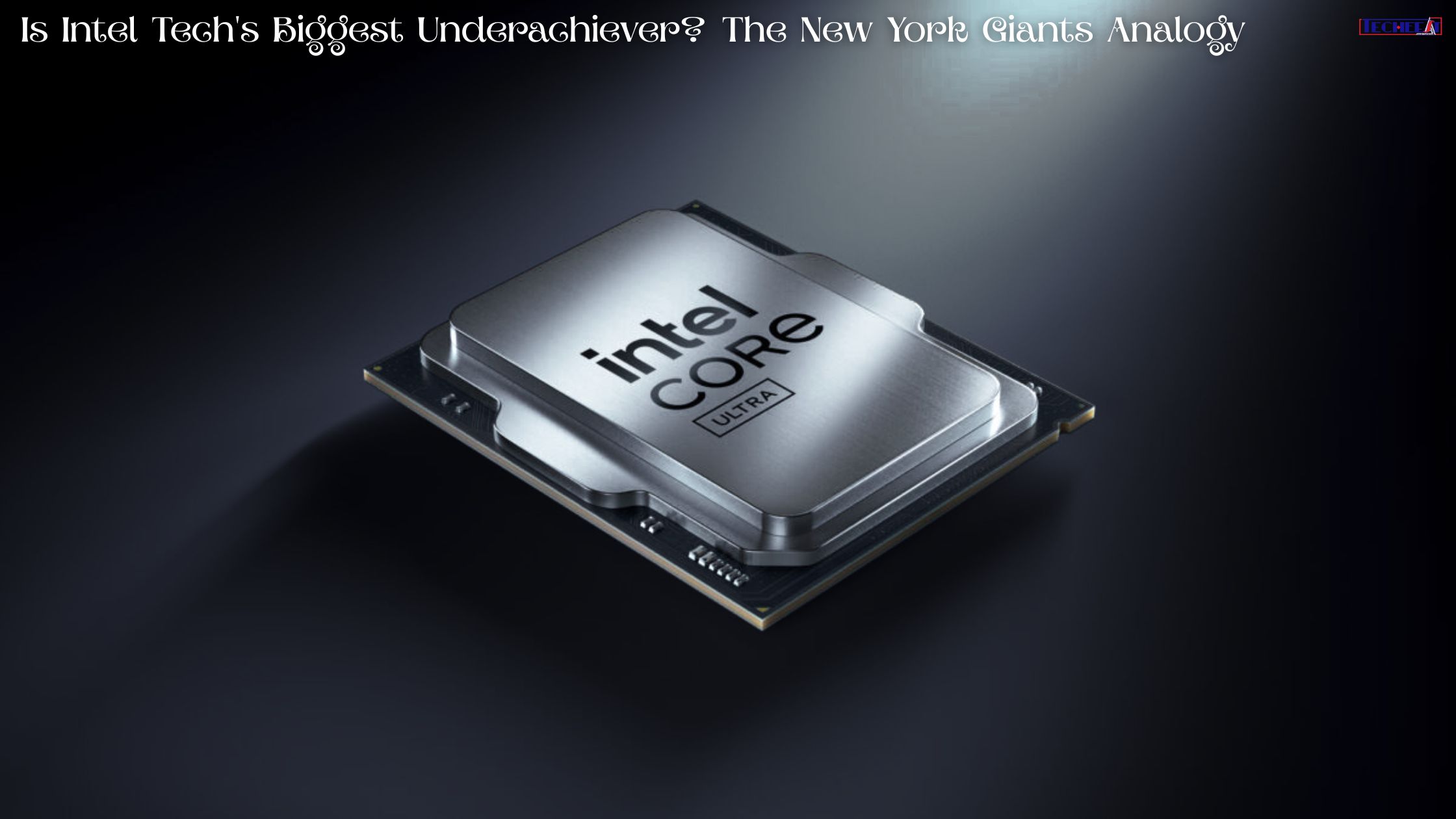
Intel Corporation, the company synonymous with the PC revolution and the “Intel Inside” campaign, was, for decades, the undisputed leader in semiconductor manufacturing, enjoying an unassailable technological and financial moat. However, over the past decade, that dominance has diminished significantly. The idea that Intel is the tech industry’s greatest overachiever—often compared to a legendary sports franchise like the New York Giants, struggling to recapture its former glory—is a compelling narrative that captures the frustration felt by investors, analysts, and even devoted customers.
This detailed analysis explores why Intel earned this title, the validity of the Giants analogy, and the massive stakes being placed in its current turnaround effort.
🏈 The New York Giants Analogy: A Story of Frustration and Lost Dominance
The comparison between Intel and the New York Giants is impressive because both organizations share a similar DNA: an old, remarkable past followed by a period of sustained poor performance despite vast resources and a foundation of excellence.
1. The Burden of a Legendary Past
Intel: In the 1990s and early 2000s, Intel defined semiconductor excellence. Its “tick-tock” manufacturing cadence delivered predictable, industry-leading performance improvements. The company’s processors were the engine of the digital world, leading to its market capitalization once exceeding $500 billion.
- New York Giants: The Giants are one of the NFL’s most decorated franchises, with multiple Super Bowl wins and a history of defining eras in professional football.
- Shared dilemma: For both, the weight of their legacies makes recent failures feel all the more devastating. When a historical champion performs poorly, the scrutiny is more intense than that of a consistently struggling unit. The expectation of excellence is a burden that Intel has struggled to carry.
2. Strategic Missteps and Cultural Inertia
Veterans Issues: The team’s recent struggles are often attributed to poor long-term roster management, questionable coaching hires, and an inability to adapt to the modern, fast-paced NFL landscape. The league has a perception of a conservative, “status quo” mentality that demands constant, aggressive growth.
- Intel’s issues (the “status quo” trap): Intel’s reliance on its traditional PC-centric worldview led to complacency and fatal strategic errors (Source 1.1).
- Missing Mobile: The company missed the smartphone revolution, ceding the entire mobile processor market to rivals like Qualcomm, which used ARM architecture (sources 1.1, 1.2).
- Lack of GPU/AI boom: While Intel focused on its CPU dominance, competitors like NVIDIA capitalized on GPUs (graphics processing units) for gaming, and later, more critically, for the massively parallel computing demands of Artificial Intelligence (AI) and Deep Learning (Source 1.3). NVIDIA’s CUDA platform became an industry standard, leaving Intel struggling to catch up (Source 2.1).
This analogy captures the essence of a massive organization that fails to adapt its winning formula to a fundamentally changed playing field.
⚙️ The Core Failure: The Manufacturing Misstep
While the strategic vision errors were costly, the deepest self-inflicted wound was the loss of process technology leadership – the crown jewel of Intel’s historical dominance.
The Delay in Innovation
Historically, Intel’s in-house manufacturing, the Integrated Device Manufacturer (IDM) model, was its greatest competitive advantage. However, when the company faltered on the transition to smaller, more complex chip sizes (or nodes), it became its Achilles heel.
- 10 nm and 7 nm delays: Intel’s transition from the 14-nanometer node to 10 nm (now branded as Intel 7) faced years of delays and production bottlenecks (Source 2.1). This was a defining moment. The company that once defined the pace of innovation is stuck.
- Rivals Leap Forward: While Intel struggled, rivals like AMD turned to a pure-play foundry model and took advantage of the advanced capabilities of TSMC (Taiwan Semiconductor Manufacturing Company) (Sources 1.1, 1.3).
- TSMC rapidly advanced to the 7nm, 5nm, and 3nm nodes (source 1.3), producing chips that were smaller, more power-efficient, and faster than what Intel could offer at the time.
- For the first time in modern history, Intel lost its technological lead to a competitor, enabling AMD to aggressively take market share in both the client (PC) and server (data center) segments (Source 2.1).
This manufacturing crisis eroded customer confidence and allowed rivals to deliver market-leading innovations, causing Intel’s client and server CPU market share to decline from 80% in 2015 to about 60% by 2024 (Sources 2.1, 2.3).
📈 Financial Reflection of Underachievement
The story of underachievement is clearly reflected in Intel’s financial and stock performance compared to its competitors over the past decade.
| Metric (LTM, Latest Trailing 12 Months) | Intel (INTC) | NVIDIA (NVDA) | AMD (AMD) |
| Market Cap ($ Bil) | 155.0 | 4,419.0 | 374.5 |
| LTM Revenue Growth | -1.5% | 71.6% | 31.8% |
| LTM Operating Margin | -0.2% | 58.1% | 9.4% |
| P/E Ratio | 782.7 (High, reflects low earnings) | 51.0 | 113.3 |
(Data is illustrative based on search results circa late 2025 (Source 2.2))
- Lagging growth and profitability: Intel’s near-zero operating margins and negative revenue growth contrast sharply with the strong double-digit growth and high margins of its competitors, especially NVIDIA, which is riding the wave of the AI boom.
- Stock Performance: While Intel’s stock has shown optimism recently (Source 2.2), its long-term performance pales in comparison to the explosion in value seen by AMD and NVIDIA, the latter of which has become one of the most valuable companies in the world. Intel’s stock struggles underscore investors’ concerns about its ability to regain its dominant position (Source 2.3).
💡 The Turnaround: IDM 2.0 and the “Hail Mary” Pass
However, there is an important counterpoint to the Giants’ analogy: losing consecutively does not mean the franchise is doomed. Intel is currently working on one of the most aggressive corporate transformation efforts in technology history, called IDM 2.0 (Integrated Device Manufacturing 2.0).
IDM 2.0 Strategy
- Recapturing Process Leadership: The aggressive plan aims to deliver five process node improvements over four years, narrow the gap with TSMC, and achieve process superiority by 2025/2026 with its Intel 18A node.
- Intel Foundry Services (IFS): This involves opening up its cutting-edge manufacturing facilities to external fabless companies (such as NVIDIA and Qualcomm), directly challenging TSMC and Samsung (Source 3.1).
- Government Support: Intel is a major recipient of government funding (like the US CHIPS Act), aimed at reinvigorating semiconductor manufacturing and diversifying the global supply chain, creating massive geopolitical advantages for Intel’s U.S.-based fabs (Sources 3.1, 3.2).
High-Stakes Execution Risk
The IDM 2.0 strategy is ambitious, and the implementation risks are substantial, compared to a high-risk, high-reward “Hail Mary” football game (Source 3.3). Reports of quality challenges with the critical 18A manufacturing process, reflected in early low yield rates for test chips, highlight the difficulty of this undertaking (Source 3.3).
- Opportunity: If Intel successfully executes its process roadmap and secures major high-volume foundry customers, it will not only secure its future but also become an important solution to the global AI manufacturing bottleneck, which is currently highly dependent on TSMC (Source 3.1).
Underachiever Label: For now, the underachiever label sticks because the results – revenue growth, operating margins, and market share (Source 2.1) – have not yet justified the company’s legacy, resource,s and potential. The next few years will determine whether Intel can shed its image as a faltering giant or whether it will cement its place as the greatest case study in corporate decency.