
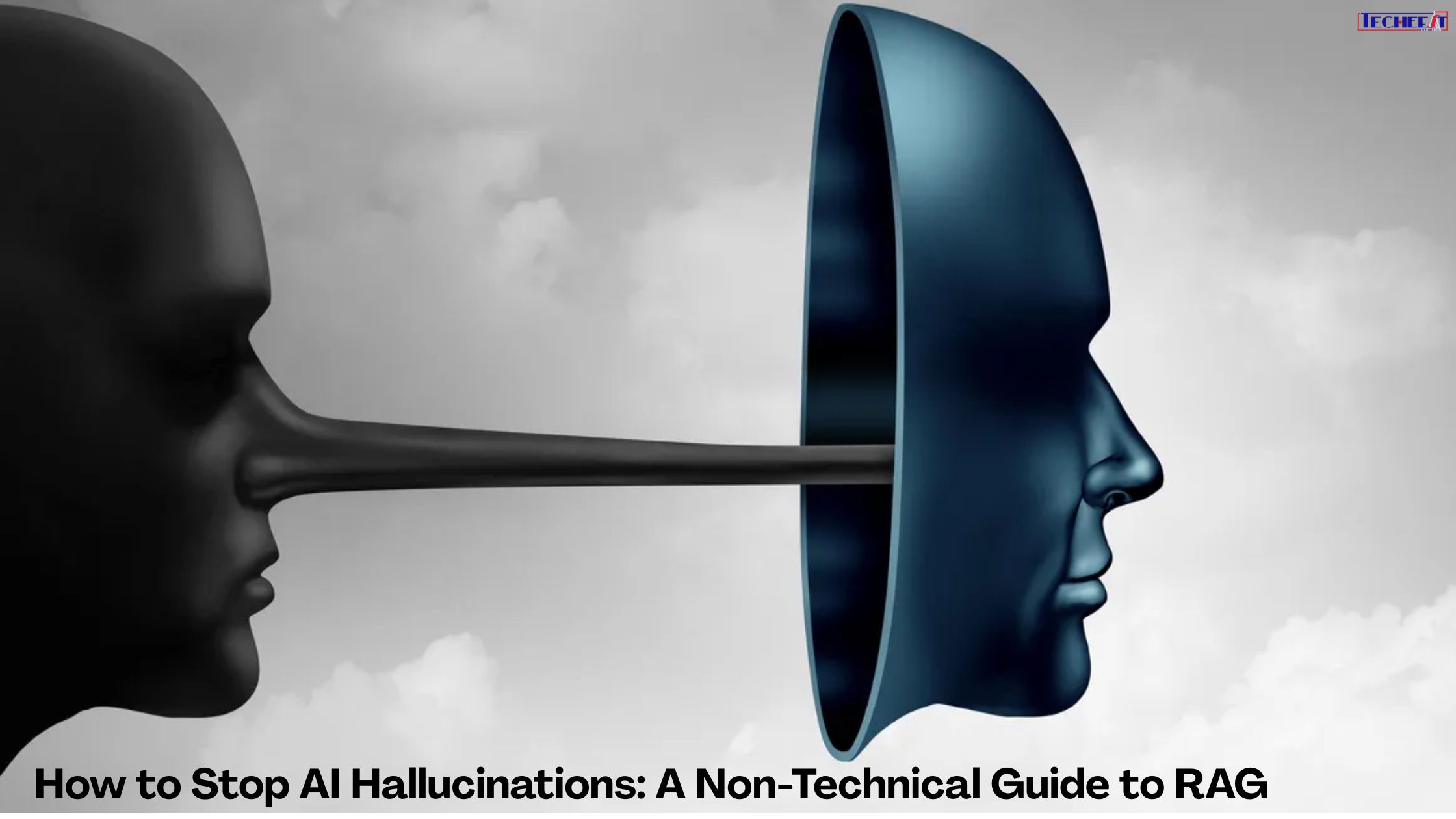
We have all been there. You ask a high-end AI chatbot a specific question—perhaps about a company policy, a niche historical fact, or a legal precedent—and it responds with absolute, unwavering confidence. The grammar is perfect. The tone is professional. But there’s one major problem: The information is entirely made up.
In the world of Artificial Intelligence, we call this a “hallucination.”
As we move through 2026, AI has become a staple of our professional lives, yet the “trust gap” remains the biggest hurdle to full adoption. Businesses cannot afford for an AI to invent a refund policy, and doctors cannot afford for an AI to hallucinate a drug interaction.
So, how do we fix it? The most effective solution isn’t “better prompting” or “praying for a smarter model.” It is a process called Retrieval-Augmented Generation, or RAG.
While it sounds like a complex engineering term, the concept is remarkably simple. Here is your non-technical guide to understanding how RAG is curing AI hallucinations and changing how we work.
The Problem: Why Does AI Hallucinate?
To understand the cure, we have to understand the disease. Popular AI models like Gemini or GPT are “Large Language Models” (LLMs). Think of an LLM as a brilliant student who has read the entire internet but finished their studies in late 2024.
- The Knowledge Cutoff: The AI only knows what it was “trained” on. If something happened yesterday, the AI doesn’t know it exists.
- The “Probability” Trap: An AI doesn’t actually “know” facts. It predicts the next most likely word in a sentence based on patterns. If it doesn’t have the facts, it will still predict words that sound factual because its primary goal is to be helpful and conversational.
When you ask a standard AI about your specific, private company data, it’s like asking that brilliant student to take a test on a textbook they’ve never seen. They will try their best to guess the answers based on general knowledge, often resulting in a hallucination.
The Solution: What is RAG?
Retrieval-Augmented Generation (RAG) is essentially giving the AI an “Open Book Test.”
Instead of relying solely on its memory (its training data), an AI equipped with RAG is given a specific set of documents—your PDFs, your emails, your manuals—to look at before it answers your question.
The RAG Process in Three Simple Steps:
- The Retrieval: When you ask a question, the system first “retrieves” the most relevant snippets of information from your private library of documents.
- The Augmentation: It “augments” your question by attaching those snippets to it.
- The Generation: It sends the question + the snippets to the AI and says: “Using only the provided information, answer this user’s question.”
The Result: The AI no longer has to guess. It becomes a sophisticated search-and-summarize tool rather than a creative fiction writer.
A Real-World Analogy: The Librarian vs. The Scholar
Imagine you walk into a massive library.
- Standard AI (The Scholar): You ask, “What are the specific terms of the Smith family’s 1920 land deed?” The Scholar has read millions of books but not that specific deed. However, they know what deeds usually look like, so they describe a “typical” 1920 deed for you. It sounds convincing, but it’s a hallucination.
- RAG AI (The Librarian): You ask the same question. The Librarian says, “Wait one second.” They run into the archives, find the physical Smith deed, bring it back to the desk, read it, and then summarize the exact terms for you.
The Librarian is using RAG. They aren’t smarter than the Scholar; they just have access to the right source at the right time.
Why RAG is the “Hallucination Killer”
RAG solves the three biggest problems with modern generative AI:
1. Real-Time Accuracy
Because RAG can be connected to live data (like a news feed or a live stock ticker), the AI’s knowledge never expires. You don’t need to spend millions of dollars “re-training” the model every time a new fact emerges; you just update the document folder.
2. Source Attribution (The “Receipts”)
One of the best features of a RAG-based system is that it can provide citations. If an AI tells you that “Project X was delayed due to a budget shortfall,” it can provide a link or a footnote to the exact PDF where it found that sentence. This allows humans to verify the information instantly.
3. Data Privacy and Security
With RAG, your private data isn’t used to “train” the global AI. The documents stay in your secure environment. The AI “borrows” the information for a split second to answer your question and then “forgets” it. This makes AI safe for legal, medical, and corporate use.
3 Ways Businesses are Using RAG in 2026
You are likely already interacting with RAG without realizing it. Here are three ways it’s being deployed right now:
1. AI Customer Support
Old chatbots used to have a list of “canned responses.” New RAG-powered bots can “read” your company’s entire knowledge base. If a customer asks a complex question about a specific product version, the bot retrieves the manual and explains the solution accurately, rather than giving a generic “I don’t know.”
2. Legal and Medical Research
Lawyers use RAG to “ask” thousands of past cases for specific precedents. Doctors use it to check a patient’s history against the latest clinical trials. In both cases, the cost of a hallucination is too high to rely on a standard AI.
3. Personal Productivity
Imagine an AI that has “read” every email you’ve ever sent, every note you’ve taken, and every calendar invite. When you ask, “When did I last talk to Sarah about the marketing budget?”, the RAG system retrieves that specific email thread and gives you a summary.
Is RAG Perfect? (The “Garbage In, Garbage Out” Rule)
While RAG significantly reduces hallucinations, it isn’t magic. It is subject to the “Garbage In, Garbage Out” rule.
- Bad Retrieval: If your filing system is a mess and the Librarian brings back the wrong book, the AI will still give a “wrong” answer based on that book.
- Conflicting Info: If you have two documents that say different things, the AI might get confused.
The key to a successful RAG system isn’t just the AI—it’s the quality and organization of your data.
Final Thoughts: Trusting the Machine
The era of “blindly trusting” an AI chatbot is over. As we integrate these tools into our core business functions, we need them to be grounded in reality.
Retrieval-Augmented Generation (RAG) is the bridge between the creative power of AI and the rigid accuracy required by the real world. By moving from “memory-based” AI to “research-based” AI, we aren’t just making these tools faster—we’re making them trustworthy.
The next time an AI gives you a perfect answer with a citation, remember: it didn’t just “know” that. It went to the library for you.