
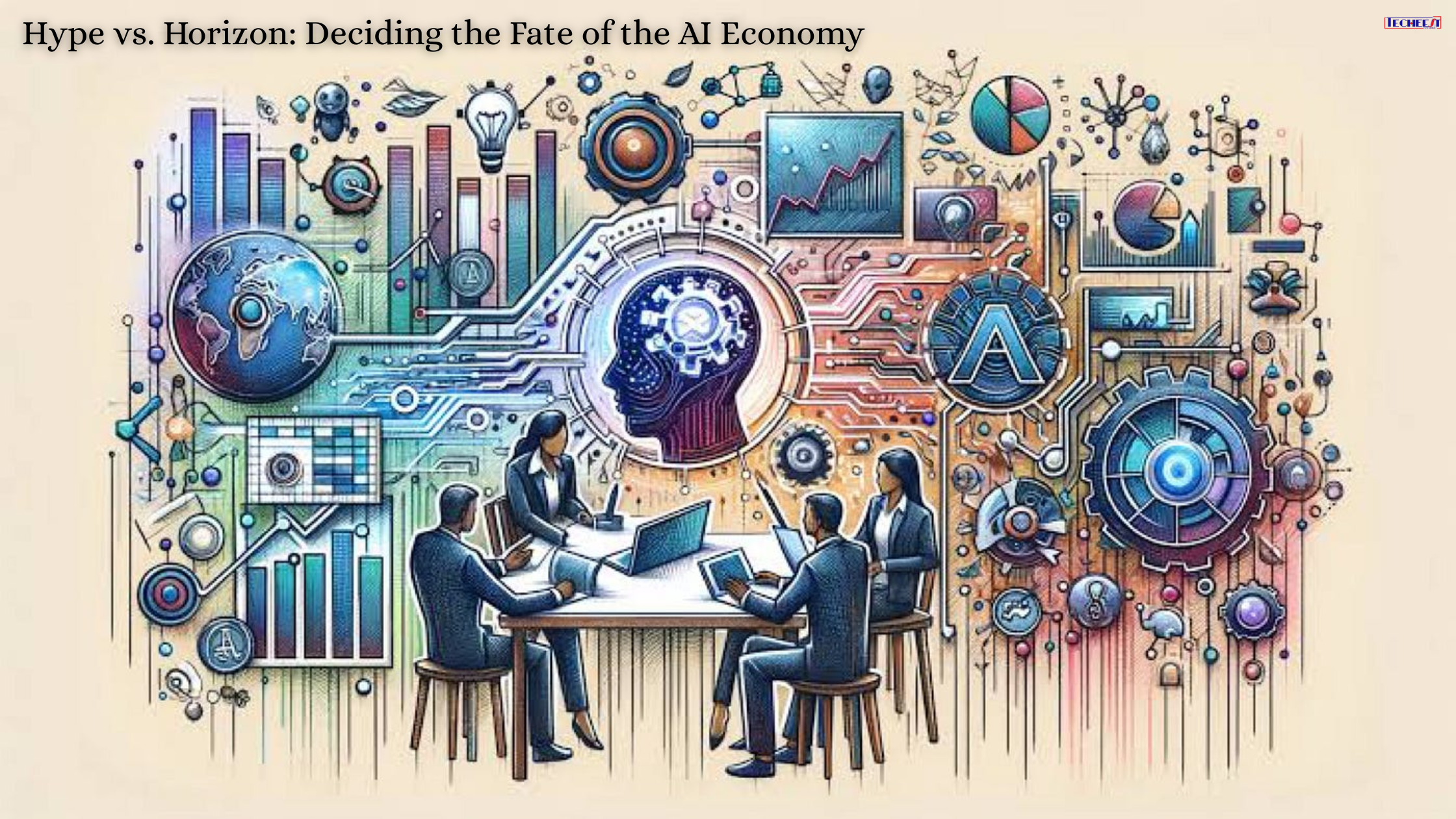
As early as 2026, the global economy stands at a worrying crossroads. For three years, we’ve been living through an “AI summer” of soaring stock prices and tempting demos. But as we enter the first quarter of this year, a new question is keeping CEOs and central bankers up at night: Is AI a sustainable economic engine, or the world’s most expensive bubble?
The narrative “What can AI do?” Is changing from. “When will AI pay off?” Here’s the current state of the AI economy, balanced between the excitement of the markets and the reality of the horizon.
1. The CapEx Tsunami: Where the Money is Going
We are currently witnessing the largest capital expenditure (CapEx) cycle in human history, dwarfing the telecom boom of the late 1990s.
- Trillion-Dollar Club: Global AI spending is projected to exceed $2 trillion in 2026.
- Physical basis: Unlike the “dot-com” bubble, which was built on virtual promises, today’s spending is based on physical reality. Billions of dollars are flowing into semiconductor fabrication, massive liquid-cooled data centers and specialized power grids.
- Sovereign Shift: 2026 sees the rise of “Sovereign AI”, where nations (particularly in the EU and the Middle East) are investing in local infrastructure to ensure they are not completely dependent on Silicon Valley’s “Magnificent Seven”.
2. The ROI Gap: Why the CFO is Frowning
While “hype” suggests AI will solve everything, “horizon” shows a significant price gap.
According to recent data, while nearly 90% of enterprises are regularly using AI in at least one function, only 34% are actually “deeply transforming” their core business processes. For many, AI remains an expensive pilot project.
| Phase | Description | 2026 Reality |
| Experimentation | Chatbots and surface-level tools. | Saturated; most companies are here. |
| Industrialization | AI embedded in supply chains and finance. | The current battleground for ROI. |
| Transformation | AI agents making autonomous decisions. | Emerging, but limited by regulation and trust. |
The Reality Check: Investors are becoming impatient. In 2026, the “proof of concept” is no longer enough. The market is now demanding “proof of profit.”
3. The Labor Market: Augmentation vs. Automation
The fear of “AI taking over all the jobs” has not yet materialized into a large-scale unemployment crisis. Instead, we see a polarized labor market.
- “Human premium”: A salary premium is being seen in roles requiring high emotional intelligence, complex physical dexterity (such as surgeons or specialized occupations) and critical thinking.
- “Entry-level erosion”: There is growing concern that AI is “eating up” key jobs – junior analyst and coding roles – making it harder for the next generation to enter the workforce.
- The productivity paradox: While AI has increased the speed of individual work in writing and coding by 40%, enterprise-wide productivity gains have been slow to show up in national GDP figures due to the time taken to reorganize entire departments.
4. The “AI Bust” Scenario: What if the Bubble Pops?
Economists at companies like Vanguard and Schroders calculate a 25-30% chance of an AI market recovery by the end of 2026.
If the bubble bursts, it will likely look like the 2001 dot-com crash: a painful recession for the tech sector, followed by a “cleanup” where only companies with real utility will survive. However, the underlying technology will not disappear – it will simply enter its mature, boring, and not really productive phase.
The Verdict: Deciding the Fate
The fate of the AI economy is not written in code; This is written into the implementation. The hype is real, but the horizon is where the real action happens.
For businesses to survive the transition from hype to horizon, the focus must shift from “buying equipment” to “redesigning workflows.” 2026 is the year we stop asking what the model can do and start asking what the business can become.