
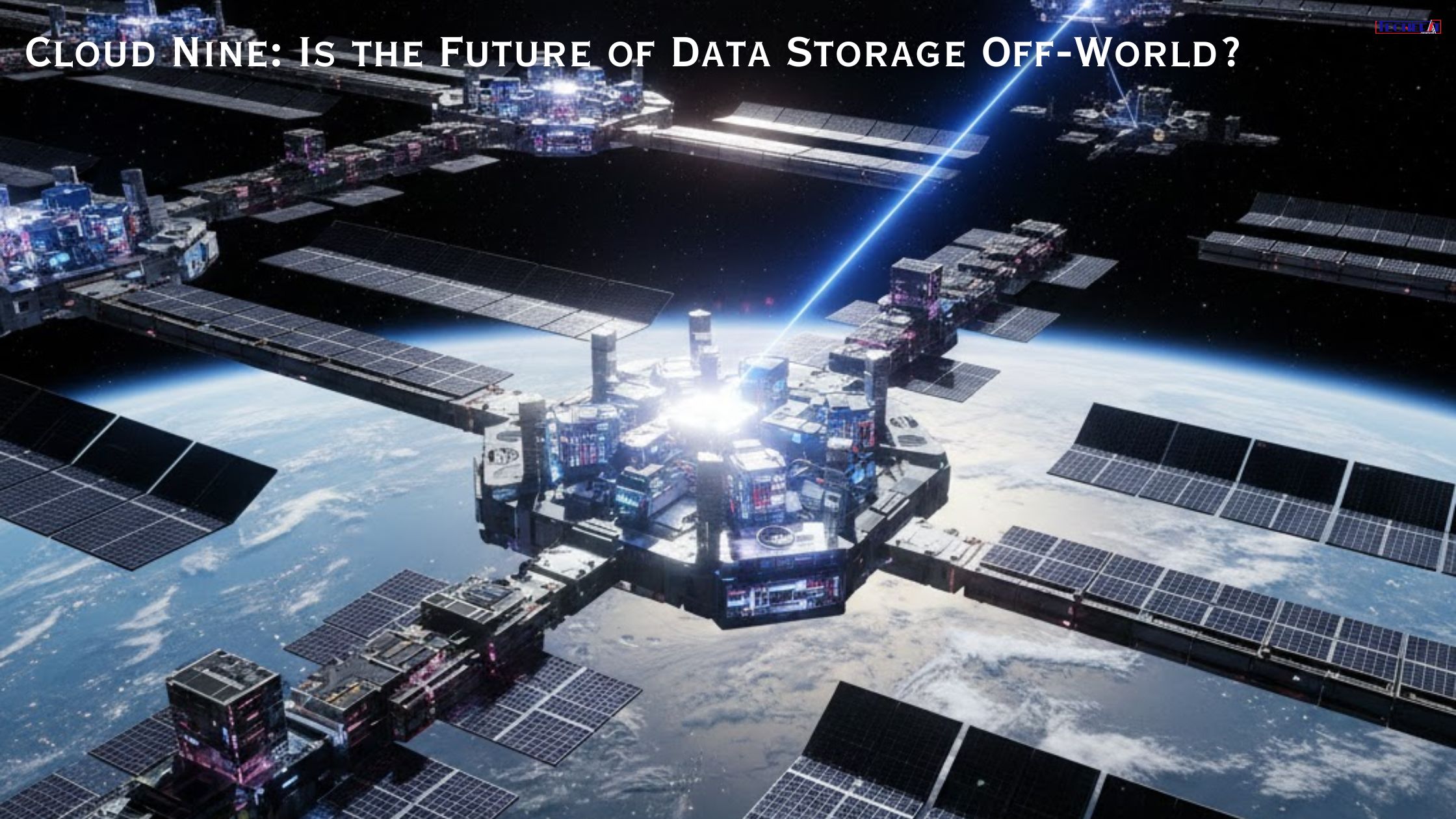
For decades, “the cloud” has been a convenient metaphor for a vast, invisible network of servers that store our photos, power our businesses, and train our AI models. But by 2026, the metaphor is becoming literal. As terrestrial data centers face an unprecedented “energy crisis,” the tech industry is looking beyond the stratosphere.
The question is no longer whether we can store data in space, but rather whether off-world infrastructure will become the backbone of the next digital age. From the moon’s cool craters to low-Earth orbit (LEO) constellations, the race is on to take the world’s most power-hungry objects into the void.
The Terrestrial Breaking Point
To understand why we are looking up, we have to look at the ground. Global data centers currently consume about 1.5% to 2% of the world’s electricity, a number projected to skyrocket as AI models like GPT-6 and Llama 5 require multi-gigawatt clusters for training.
Terrestrial data centers face three existential “walls”:
- Energy Wall: In the US alone, data centers could consume up to 9% of total electricity generation by 2030. May not support many local grid extensions.
- Water Wall: Cooling traditional data centers requires millions of gallons of fresh water per day. The 40-MW cluster could consume more than 1 million tons of water annually, often in areas already suffering from drought.
- Regulation Wall: Land-use permits, community opposition to large-scale server “farms”, and environmental taxes are making Earth-based expansion slower and more expensive.
Step 1: Harnessing the “Infinite Battery” (Solar Power)
The most immediate benefit of space-based data centers is energy. On Earth, solar panels are limited by the atmosphere, weather, and the inevitable arrival of night.
In a sun-synchronous orbit (SSO), a satellite data center can receive unfiltered sunlight 24/7.
- Efficiency: Solar radiation in orbit is about 36-40% higher than at the surface.
- Compatibility: Space-based arrays can achieve a capacity factor of more than 95%, compared to about 24% for terrestrial solar farms.
- Cost: Startups like StarCloud estimate that once the initial launch hurdle is overcome, the cost of energy in space could be 10 to 15 times less than wholesale electricity prices on Earth.
By relocating “chips” next to power generation, we eliminate the 5-10% energy losses that occur when transmitting power across long-distance terrestrial grids.
Step 2: The Vacuum as a Heat Sink
Cooling is the “Achilles Heel” of modern computing. On Earth, we use massive fans and water chillers to fight the heat generated by GPUs. In space, we have the opposite environment: the almost-absolute void of vacuum.
While the vacuum of space is an insulator (making heat conduction impossible), it is perfect for radiative cooling. By using large, passive radiators, data centers can emit waste heat as infrared radiation directly into the void. This eliminates the need for a drop of fresh water, making “orbital clouds” potentially the most sustainable way to accelerate the AI revolution without further depleting Earth’s resources.
Step 3: Prototyping the Orbital Cloud (Key Players)
We are already past the theoretical stage. In late 2024 and throughout 2025, several milestones proved that off-world storage is a viable commercial product.
| Successfully landed a shoebox-sized hardware on the Moon to test as “humanity’s backup drive.” | Initiative | Status (2026) |
| Starcloud | “Starcloud-1” Satellite | Successfully launched with NVIDIA H100 GPUs for orbital AI training. |
| Project Suncatcher | Researching high-bandwidth laser links for “clusters of clusters” in orbit. | |
| Lonestar | Lunar Data Centers | Successfully landed shoebox-sized hardware on the Moon to test as “humanity’s backup drive.” |
| Axiom Space | Axiom Station | Integrating data center modules into the first commercial space station. |
The emergence of reusable rockets (like SpaceX’s Starship) has been the primary catalyst, dropping the cost per kilogram to a level where launching heavy server racks is no longer a financial impossibility.
Step 4: The Moon as “Humanity’s Hard Drive”
While LEO is great for active processing, the Moon offers a unique advantage for long-term storage: physical security and isolation.
Data stored on the lunar surface is protected from Earth-based natural disasters, geopolitical conflicts, and physical sabotage. For governments and financial institutions, the Moon represents the ultimate “air-gapped” vault.
- Low latency for space exploration: As we establish permanent bases on the Moon (Artemis program), we will need local data processing to avoid the 2.5 second round-trip delay on Earth.
- Global Archive: Projects are already underway to store “humanity’s backups,” including DNA sequences, historical records, and the world’s open-source code, in lunar lava tubes.
Step 5: Overcoming the Challenges
Despite the promise, the “off-world cloud” faces significant obstacles:
- Radiation: Galactic cosmic rays can cause “bit flips” (data corruption). Heavy shielding or advanced software error-correction (FEC) is required to ensure data integrity.
- Kessler Syndrome: The more satellites we launch for data storage, the greater the risk of orbital debris collisions. Responsible “de-orbiting” protocols are required.
- Latency: For real-time applications like gaming, the 500-mile trip to LEO and back is still a challenge. As a result, the first wave of space data will likely be for AI training and archival storage, where milliseconds don’t matter as much.
Key Term: Edge-at-the-Edge. This refers to processing data directly on the satellite that collects it (like Earth observation sensors) rather than beaming raw data down to Earth. It saves massive amounts of bandwidth.
Conclusion: A Multi-Planetary Infrastructure
As we move deeper into 2026, the transition to off-world storage feels less like science fiction and more like a logical economic development. By sending our most resource-intensive digital functions into space, we allow Earth’s power grids to focus on homes and hospitals, while the “cloud” ultimately remains where it belongs: among the stars. The future of data storage isn’t just a bigger hard drive; This is a new class.