
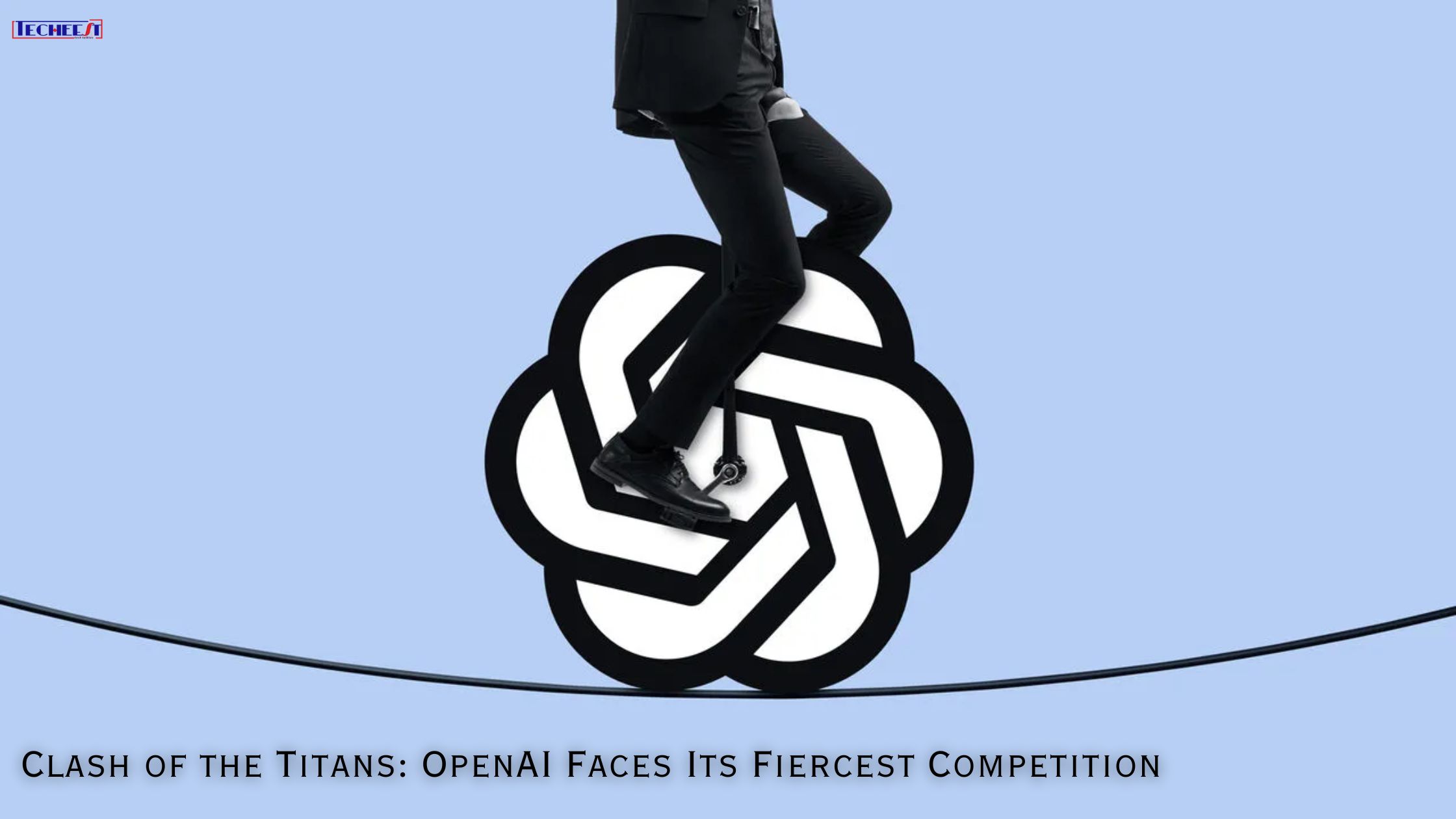
For nearly three years, the name OpenAI was synonymous with “AI Revolution”. Since ChatGPT’s launch in late 2022, the San Francisco-based lab has enjoyed a near-monopoly on the public’s imagination and enterprises’ pocketbooks.
But as we enter 2026, the scenario has changed. “Titan” is no longer alone on the mountain. A relentless wave of competition – from trillion-dollar tech giants to lean, hyper-efficient international laboratories – has turned the AI race into a high-risk war of attrition. OpenAI, once the undisputed leader, now finds its market share under pressure, its talent being poached, and its “moat” being challenged by models that are faster, cheaper, and in some cases smarter.
The Erosion of the Empire: By the Numbers
To understand the “struggle,” one has to look at the changing market dynamics. By early 2024, OpenAI captured nearly 90% of the traffic in the consumer chatbot market. Fast forward to today, and this dominance has dropped to between 60% and 68%.
While ChatGPT remains the most recognized brand, the growth of competitors like Google Gemini – which is set to triple its market share in 2025 alone – proves that “first-mover advantage” is a fleeting luxury in the age of exponential intelligence.
The Three Fronts of the AI War
The competition against OpenAI is not coming from one direction; This is a pincer movement that involves three different types of opponents.
1. The Ecosystem Titans: Google & Microsoft
If OpenAI’s strength is innovation, Google’s strength is ubiquity. With the release of the Gemini 3 Pro, Google has finally closed the capability gap. Gemini’s “killer app” isn’t just its logic; This is its integration.
- The Mote: Gemini is natively baked into Android, Gmail, and Google Workspace. For billions of users, the “easiest” AI to use is the one that’s already in their inbox.
- Infrastructure advantage: While OpenAI struggles for chips, Google builds its own TPUs (tensor processing units), allowing them to serve massive 2 million-token context windows at a fraction of the cost.
Meanwhile, a subtle tension has emerged with Microsoft. While they remain OpenAI’s largest investor, Microsoft has begun to diversify, investing heavily in Anthropic and building its own “MAI-1” internal model to reduce its total reliance on Sam Altman’s lab.
2. The Efficiency Disruptors: DeepSeek & the Open-Source Wave
Perhaps the most shocking blow to OpenAI’s armor came from DeepSeek. In early 2025, the release of DeepSeek-R1 shocked Silicon Valley.
- The $6 million miracle: While OpenAI reportedly spent hundreds of millions (some estimates exceed $1 billion) to train its Frontier models, DeepSeek achieved comparable reasoning performance with a training budget of only $5.6 million.
- Pricing war: DeepSeek-R1 is about 30 times cheaper than OpenAI’s O1 for developers. This has forced OpenAI to “pull” release dates and cut API prices to prevent a mass exodus of startups in search of cost-effective alternatives.
3. The Specialist: Anthropic (Claude)
If OpenAI is the “everything app”, Anthropic has branded itself as the “secure and professional” alternative. Their Cloud 4 series has become a darling of the enterprise world, especially in the legal, coding, and research sectors.
- Coding superiority: In recent benchmarks such as SWE-Bench, Cloud Opus 4.5 has consistently outperformed GPT-5 variants in autonomous software engineering tasks.
- Consensual AI: Anthropic’s focus on “security by design” has won over highly regulated industries (finance, healthcare) that are wary of OpenAI’s “move fast and break things” reputation.
The Hardware Arms Race: Stargate and Beyond
The competition has moved from the screen to the soil. The “Clash of the Titans” is now a battle of Gigawatts.
| Project | Partner | Investment | Goal |
| Stargate | OpenAI & Microsoft | $500 Billion | 20+ Gigawatt supercomputer cluster |
| Hyperion | Meta | $72 Billion (2025) | 5-Gigawatt “AI Supercluster” in Louisiana |
| Project Rainier | Amazon (AWS) | $125 Billion | 2.2-Gigawatt data center running Trainium 2 chips |
OpenAI is no longer competing on code alone; It is competing on real estate and energy. The company that can achieve the most power and the most cooling capacity will ultimately win the race to superintelligence (ASI).
The Ideological Split: Closed vs. Open
The stiff competition OpenAI faces isn’t just a company – it’s an idea.
- OpenAI’s approach: A proprietary, “closed-source” model where they control security, weight, and monetization. They argue that this is the only way to safely reach AGI.
- Meta’s Vision: Mark Zuckerberg’s Llama 4 has become the industry standard for “open-vets” AI. By giving away the model for free, Meta has turned the developer community into its own R&D department.
By 2026, most startups will no longer ask “How do we get the OpenAI API key?” But rather, “Can we run a great Llama 4 locally for half the price?”
Can OpenAI Hold the Crown?
Despite stiff competition, it would be a mistake to count OpenAI out. They still have a group of the world’s most talented AI researchers and a brand name that has become a verb.
To stay ahead, OpenAI is moving toward agentic AI. The goal of 2026 is no longer a chatbot that talks to you, but an AI agent that does the work for you – navigating your computer, managing your calendar, and executing multi-step business workflows autonomously.
Challenges ahead:
- Blood of talent: Prominent researchers (such as Ilya Sutskever and Andrzej Karpathy) have left to start their own ventures (SSI, Eureka Labs), weakening OpenAI’s intellectual monopoly.
- Regulatory scrutiny: As the leader, OpenAI faces the brunt of global AI security investigations and copyright lawsuits.
- Pressure to Monetize: With a valuation of over $150 billion, there is huge pressure to make profits while computation costs remain very high.
Final Thoughts: The Winner is the User
As these titans collide, the real winner is the consumer. In 2023, “AI reasoning” was a luxury. In 2026, high-level intelligence has become a commodity due to stiff competition from DeepSeek, Google, and Meta. OpenAI is no longer the only game in town – it’s one of many powerful gods in a crowded pantheon. Whether they remain the “King of Kings” depends on their ability to innovate fast enough for the world to copy.